Lviv hosted the Third Ukrainian Conference on Adaptive Football: sport, support for veterans and new opportunities for reintegration
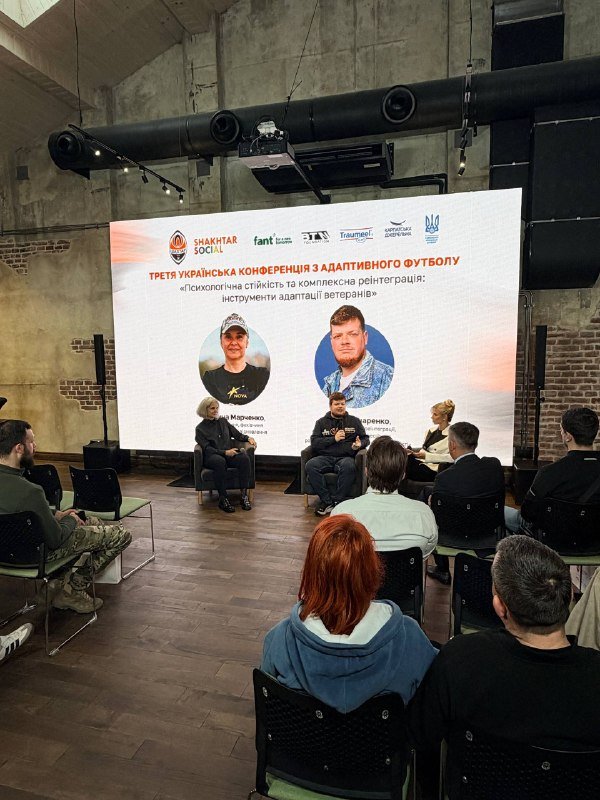
On 28 October, Lviv hosted the Third Ukrainian Conference on Adaptive Football, organised by Shakhtar Social. The event brought together representatives of the football community, veterans, international partners, psychologists, educators and rehabilitation specialists.
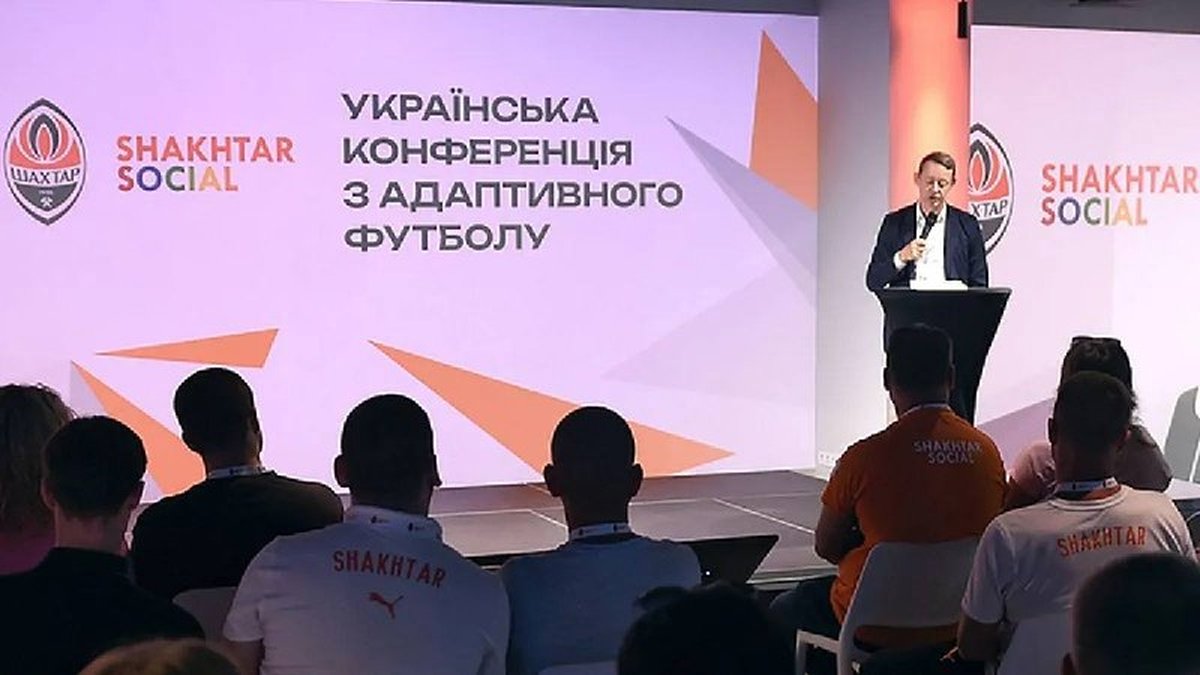
On 28 October, Lviv hosted the Third Ukrainian Conference on Adaptive Football, organised by Shakhtar Social. The event brought together representatives of the football community, veterans, international partners, psychologists, educators and rehabilitation specialists. Participants included Andriy Pyatov, veterans and representatives of organisations that develop adaptive sport and comprehensive support for the defenders of Ukraine.
The media partner of the conference was the website “Ukrainian Football”.
The event became a platform for discussing not only sporting achievements and the prospects of amputee football, but also a broader question: how to help people who have lived through the war and sustained severe injuries return to an active social, professional and personal life.
Adaptive football is more than a sport
Conference participants discussed the development of children’s adaptive football in Ukraine, international partnership, the psychological recovery of veterans, the role of business in supporting adaptive sport, and the challenges of holding national competitions during the full-scale war.
Special attention was paid to cooperation between Ukraine and Denmark, which opens new prospects for developing amputee football and applying international experience.
Vitaliy Manko, a representative of the Ukrainian Association of Football, spoke about the systemic development of children’s adaptive football, while Natasja Vestmo, project manager at FANT, presented international experience and the prospects of the Ukrainian-Danish partnership.
An important topic was turning individual social initiatives into sustainable programmes. This was the subject of the panel discussion “From a social initiative to a sustainable system”, which brought together Ukrainian IT entrepreneur and investor Roman Balashov, Shakhtar Stalevi head coach Bohdan Bilko and project manager Anton Tykhomyrov.
Psychological resilience and comprehensive reintegration of veterans
One of the key thematic strands of the conference was the panel discussion “Psychological resilience and comprehensive reintegration: tools for veterans’ adaptation”.
It featured psychologist and mental recovery specialist Halyna Marchenko and Artem Honcharenko, head of the Institute for Reintegration, Rehabilitation and Professional Development of Veterans “Architecture of Resilience” at the Kyiv National University of Construction and Architecture (KNUBA).
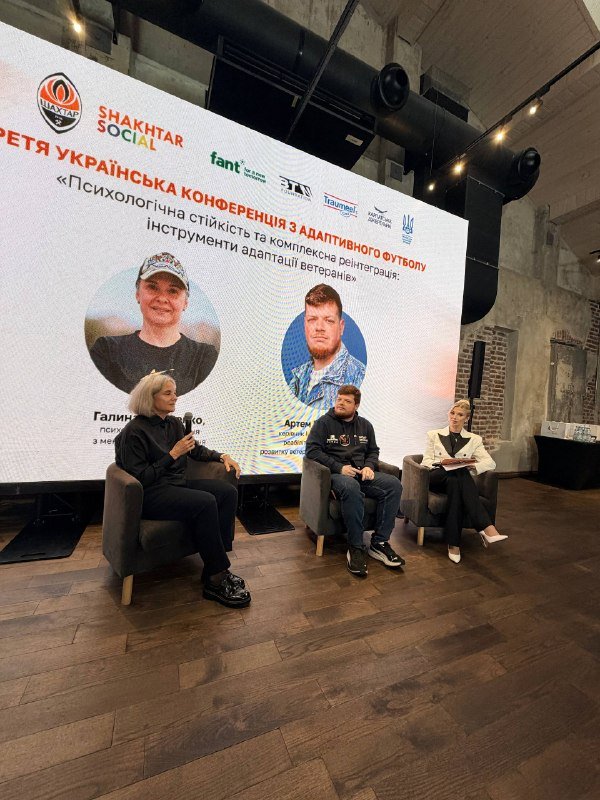
The discussion focused on the links between psychological recovery, adaptive sport, social adaptation and veterans’ professional fulfilment.
Returning to civilian life after combat often requires not only physical recovery but also rethinking life goals, restoring social ties and finding new opportunities for self-fulfilment.
Adaptive sport plays a special role in this process. Teamwork, shared achievements, the support of fellow soldiers and a sense of belonging to a sporting community can help restore self-confidence and psychological resilience.
At the same time, successful reintegration should not end on the sports field. After rehabilitation, veterans face new questions: where to study, how to retrain, find a job, start their own business and provide for their family.
KNUBA Veterans Institute: from rehabilitation to education and employment
A practical example of this approach is the work of the Institute for Reintegration, Rehabilitation and Professional Development of Veterans “Architecture of Resilience” at KNUBA, headed by Artem Honcharenko.
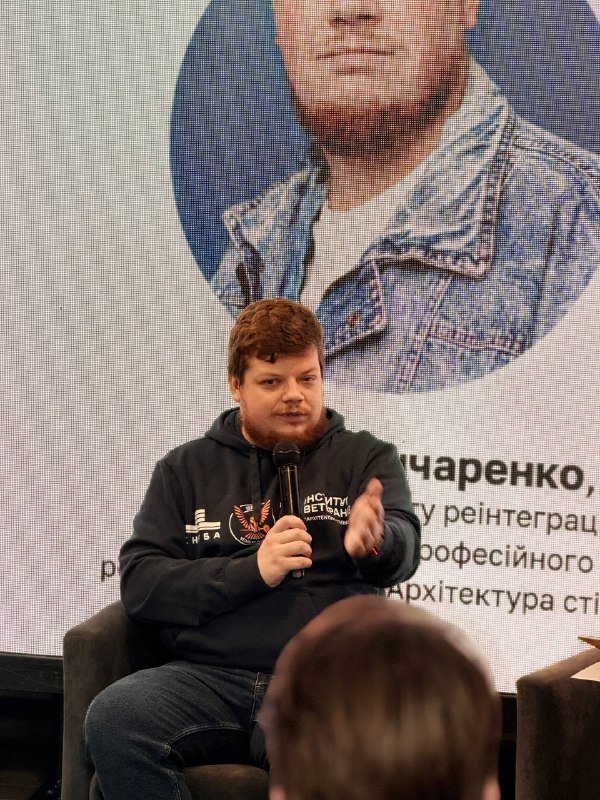
The institute is building a comprehensive support system for veterans, both men and women, serving military personnel, their family members and people affected by the war.
The model combines identifying individual needs, psychological and social support, and help in accessing rehabilitation services, education, vocational training, retraining and employment.
What makes this approach distinctive is that a veteran is seen not merely as a recipient of social assistance, but above all as a person with experience, knowledge, skills and considerable potential for the development of society.
As part of the institute’s work, veterans and their family members are already studying in various fields, gaining new skills and opportunities for professional fulfilment.
These fields include construction and architecture, information technology, cybersecurity, ecology, public administration, management and other areas important for Ukraine’s economic development and reconstruction.
An important part of the institute’s work is cooperation with educational institutions, employers, civil society organisations and the Veterans Cluster of Ukraine.
The ultimate goal is an employed veteran or a veteran entrepreneur able to provide for their family, keep developing and take an active part in public life.
Sport, education and work should become a single system
One of the key conclusions arising from the conference agenda is the need to strengthen cooperation between sporting, rehabilitation, educational and professional institutions.
Adaptive football can be a veteran’s first step back to an active life. The next stage, however, must be access to opportunities that secure their long-term social and economic independence.
For example, a veteran taking part in amputee football training can at the same time receive psychological support, go through career counselling, study at university or learn a new profession.
In the longer term, such mechanisms can bring together sports clubs, universities, rehabilitation centres, veterans’ organisations, employers and local self-government bodies.
It is important that support also extends to veterans’ families, which play a substantial role in adaptation and recovery.
Business and international partners are an important part of development
Several conference presentations were devoted to involving business in the development of adaptive sport, supporting rehabilitation programmes and international cooperation.
In particular, Maryna Chekaliuk, director of the Ukrainian Academy of Biological Medicine, spoke about the role of corporate partnership in recovery in the context of cooperation with Traumeel S Gel and the development of adaptive sport in Ukraine.
Such partnerships show how sports organisations, business, the medical community and the civic sector can join forces for shared social goals.
Andriy Pyatov: the strength of the team, mentoring and resilience
An important closing stage of the conference was the panel discussion on the role of the team, mentoring and psychological resilience in professional and adaptive sport.
They were joined by Shakhtar Social ambassador and Shakhtar goalkeeper Andriy Pyatov, Azov Regiment veteran and Shakhtar Stalevi player Vladyslav Klymenchuk, and Mariupol defender Volodymyr Vdovenko.
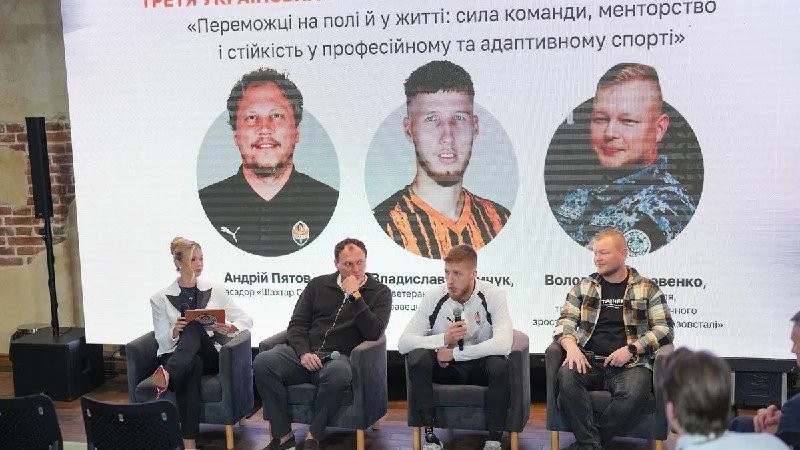
The discussion brought together experience from professional football, military service and adaptive sport. Mentoring, mutual support and team responsibility take on particular importance.
From individual sports projects to a sustainable system of support for veterans
The Third Ukrainian Conference on Adaptive Football showed that the development of this sport in Ukraine is gradually moving beyond individual teams and competitions.
Alongside the development of amputee football, questions of accessible sports infrastructure, psychological support, international partnership, education, employment and long-term reintegration are gaining weight.
The first two Ukrainian conferences on adaptive football held by Shakhtar Social took place in Kyiv in 2024 and 2025. In 2026, Lviv hosted the event for the first time.
True success in reintegration is not only a person’s return to the sports field. It is their ability to shape their own future, study, work, start a business, support their family and remain an active part of society.
It is precisely such cooperation that can underpin long-term support for Ukrainian veterans, both men and women, and the building of a resilient, inclusive society.