$480 BILLION “BURNED” ON THE STOCK MARKET: THE AI BUBBLE HAS BURST IN CHINA. IS THE US NEXT?
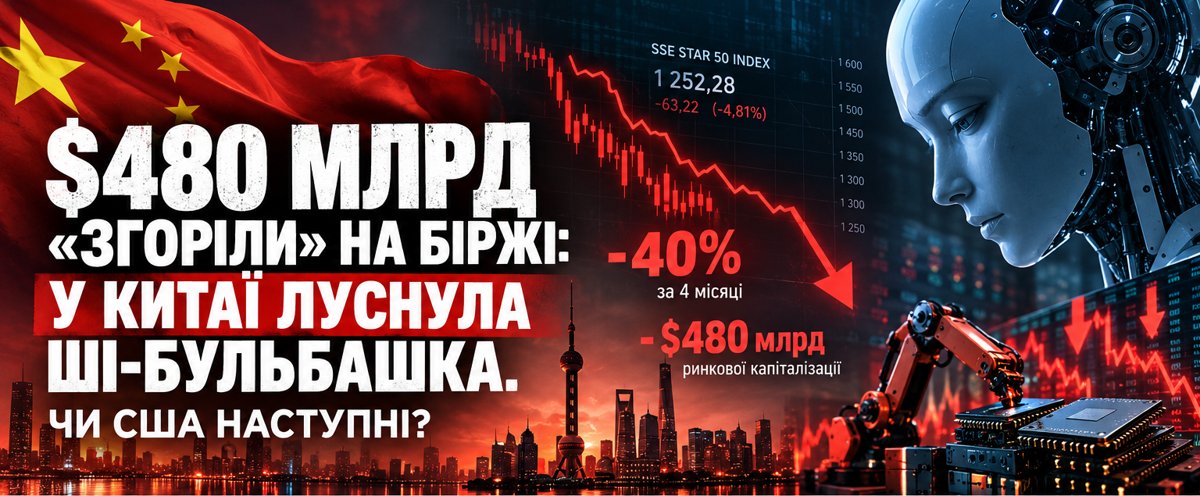
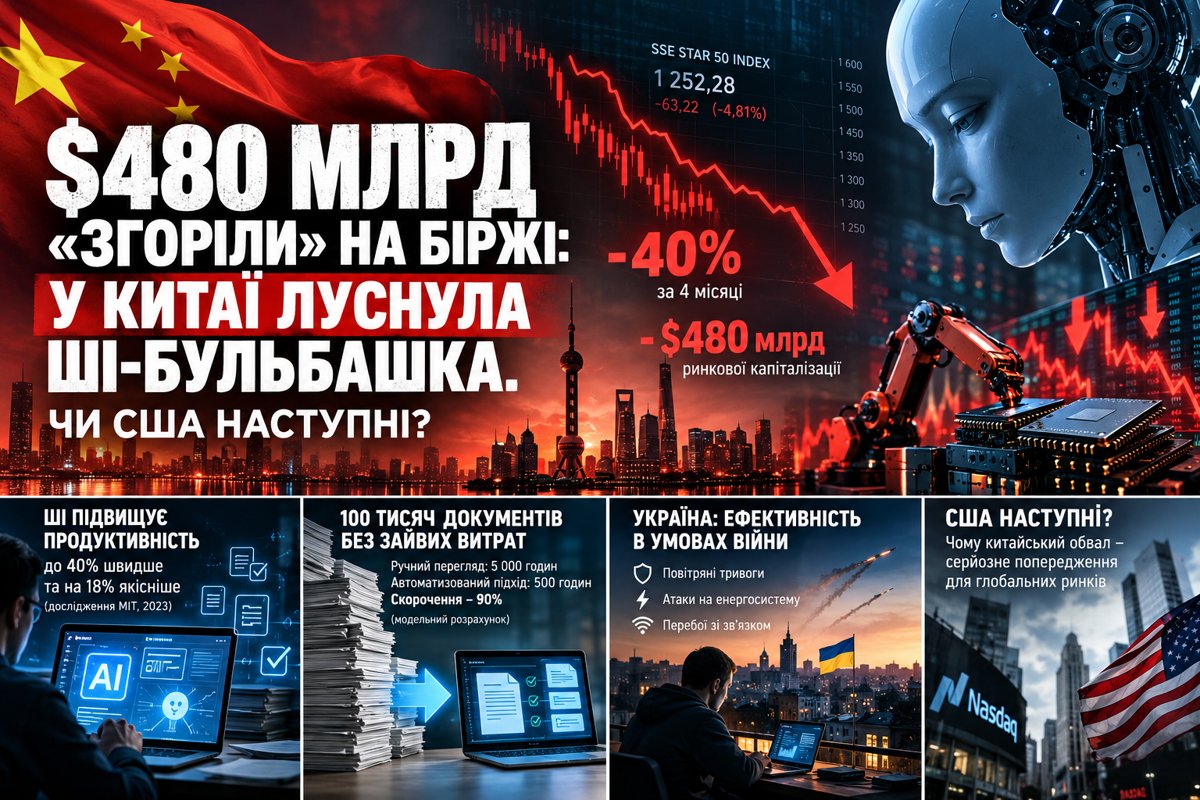
China’s STAR 50 technology index fell by roughly 40% in less than four months, and the estimated loss of market capitalization reached $480 billion. Does this mean the end of the enthusiasm for artificial intelligence? I am convinced it does not. The financial market tests prices and expectations, whereas the real effectiveness of a technology must be judged by the results it delivers for people, the economy and the state.
Artem Honcharenko, PhD
Head of the Veterans Reintegration, Rehabilitation and Professional Development Institute “Architecture of Resilience” of KNUBA
October 27, 2026 • author’s analysis
| -40% STAR 50, in under 4 months | $480 billion Market capitalization lost | -4,81% 27.10.2026, in a single day |
The Chinese crash: what really happened to the market
Not long ago, makers of chips, optical components for data centers and robotics were called the main winners of the new technological revolution. Investors bought their shares, counting on growing future demand for artificial intelligence. At the end of October that confidence gave way to a massive sell-off.
According to Reuters, October 26, 2026, the STAR 50 index, which tracks the performance of leading technology and innovation companies on the Shanghai exchange, lost about 40% in less than four months. The total loss of market value is estimated at roughly $480 billion. On October 27 the index closed at 1,252.28 points, a one-day decline of 4,81%. [1–2]
Two clarifications matter here. STAR 50 is not a list of China’s 50 largest purely AI companies, but an index of the technology and innovation segment, where many companies are linked to semiconductors and AI. And $480 billion did not “vanish” from companies’ bank accounts: what fell is the market valuation of their shares.
Even so, the scale of the correction does not shrink. Reuters cites examples of shares of individual makers of robots, chips and optical equipment falling by tens of percent. The market suddenly remembered a simple economic requirement: a good technology does not by itself guarantee profits sufficient to justify any share price. [1]
Why the market cooled: inflated expectations versus real profits
At the peak of the rally, the price-to-earnings (P/E) multiple for the STAR 50 index, by Reuters’ estimate, approached 250. Even after the sharp decline it stood at about 100, while the benchmark for the Nasdaq 100 in the same article is roughly 30. The two indexes are not identical in structure, but the gap shows how much future growth investors had already priced into Chinese quotations. [1]
High valuations were joined by doubts about the pace of demand for AI hardware, possible export restrictions, tax factors and risks to sales of Chinese components to data centers abroad. None of these reasons alone explains the entire crash, but together they made the market vulnerable.
My conclusion is simple: we need to separate the price of a share from the usefulness of the technology. A company can make a needed product and still be unjustifiably expensive on the stock market. Conversely, a drop in its share price does not cancel the technological effect already achieved.
Two things need to be clearly separated: the economic effectiveness of artificial intelligence and the speculative value of the companies that earn money from it. The stock market can be wrong in its expectations. But if a technology really cuts research time, raises productivity and makes it possible to reach well-founded decisions faster, that value does not disappear along with falling share prices.
Does AI really speed up human work: what is proven and what is merely promised
As a researcher, I believe artificial intelligence should be assessed not by the loudness of presentations but by independent experiments with control groups. And such studies already exist.
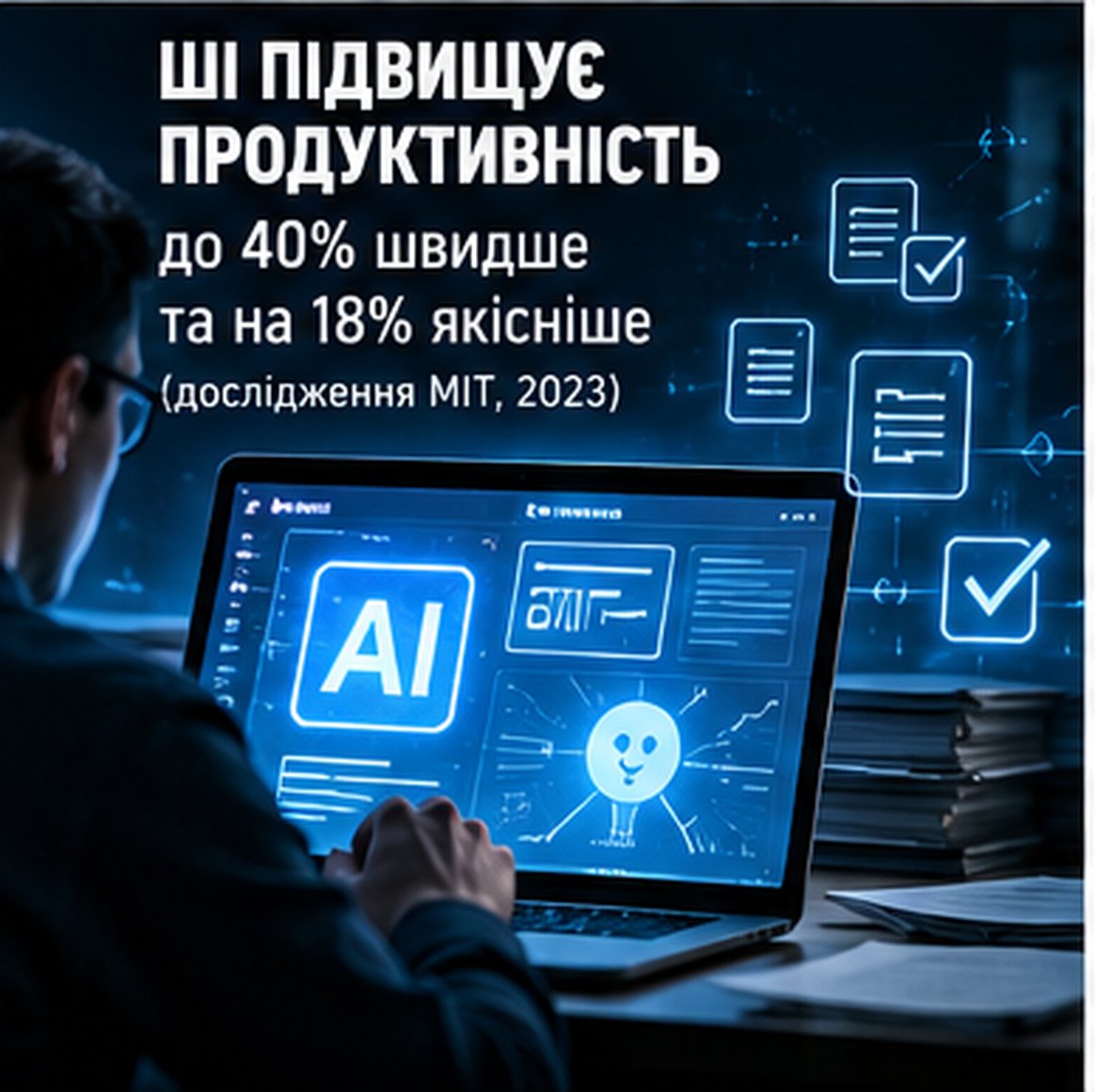
In an MIT study published in the journal Science in 2023, 453 professionals performed professional writing tasks. In the group with access to ChatGPT, the average completion time fell by 40%, while the quality of the output, as rated by experts, rose by 18%. This is a real experiment, but it does not prove that any complex research will automatically speed up by the same 40%. [3]
In an experiment by Harvard Business School and Boston Consulting Group involving 758 consultants GPT-4 users completed tasks matched to the model’s capabilities more than 25% faster and finished more than 12% more tasks. At the same time, on a task outside the tool’s reliable capabilities, using AI led to a worse result. [4]
Scientific analysis is especially telling. A review of 25 studies, published in Frontiers in Pharmacology in 2025, recorded time savings of more than 50% in 17 of the papers. In some cases, automated abstract screening was shortened by a factor of 5–6, while the manual workload, provided 95% recall of relevant material, by a factor of 6–10. This is mostly about individual selection stages, not about the whole path from an idea to a verified conclusion. [5]
There is also a caveat. In a randomized METR experiment in 2025, 16 experienced developers, who carried out 246 real tasks, took on average 19% longer, although they themselves believed they had sped up. Thus a tool that helps a beginner can slow down a specialist on familiar work if the cost of checking the results is too high. [6]
Conclusion: we must measure not the volume of generated text but the number of correct and verified results per unit of time.
One example that changes the scale: 100,000 documents
Imagine an organization that needs to carry out an initial review of 100,000 documents — contracts, scientific publications, reports, citizens’ appeals or reconstruction materials. If only three minutes is spent on each document, that makes 5,000 person-hours, that is, 625 eight-hour working days. A team of ten analysts working at full capacity would need about 12.5 weeks.

Now suppose a verified system automatically performs deduplication, initial classification and contradiction search, and produces a list of exceptions. If its quality makes it possible to cut specifically the manual screening by 90%, what remains is the equivalent of 500 person-hours at this stage.
| Indicator | Traditional process | Hybrid scenario |
|---|---|---|
| Number of documents | 100 000 | 100 000 |
| Manual initial review | 5,000 h | 500 h |
| Reduction in manual screening | — | 90% (assumption) |
| Final conclusion | Human | Human after verification |
This is an illustrative model, not the result of a specific implementation. It does not separately account for the cost of computing, setup, quality control or missed critical cases. So one cannot mechanically claim a tenfold speedup of the whole study.
But it explains where the real value arises: the expert no longer has to review every single piece of information by hand once automated selection has proved the required accuracy. He or she moves from mass reading to in-depth work on complex cases.
The market is starting to mature. The mere promise of a technological revolution is no longer enough. Investors want to see profit, and organizations want a concrete result: how much time has been saved, how many errors prevented, how many requests processed and how much it costs to maintain the system. The real competitive advantage will belong to those who can prove the economic effectiveness of AI.
War changes the productivity formula: why this matters for Ukraine
In our country an employee can be highly skilled and motivated yet unable to cancel an air-raid alert or a missile attack. People’s safety must always remain the priority.

In a survey by the European Business Association conducted in February 2026 among 131 top executives from member companies of the Association, 45% of respondents named work stoppages during air-raid alerts among the common constraints, and 82% named attacks on the energy system among the factors with the greatest negative impact on business. This is not a statistic for the average loss of hours across Ukraine as a whole, but it is weighty evidence of operational obstacles. [7]
Take a hypothetical project that requires 100 productive analytical hours. If the actual availability of working time is 70%, completing it will take about 143 hours of planned working resource. In a modeled hybrid process, where 25 hours remain for the human and machine processing and accompanying operations add 10 hours, the total estimate is about 46 hours. The difference is roughly a factor of 3.1.
These numbers should not be taken as a benchmark for Ukrainian companies: 70% availability and the structure of operations here are merely scenario assumptions. The real effect will be determined by the nature of the tasks, the readiness of the data and the architecture of the system.
The principle, however, matters. If computing, data and task queues are properly backed up and geographically distributed, some operations can continue even while employees are in a shelter. If, on the other hand, the system is tied to a single office server without backup connectivity and power, there will be no such advantage.
For Ukraine, using artificial intelligence is not just a wish to be technologically modern. It is a question of resilience. People have the right to safety, rest and protection during war. At the same time, properly built digital infrastructure can ensure the continuity of some critical processes. Our task is not to replace people but to strengthen their capabilities with technology.
The main revolution is not text in a minute but spotting the problem before the report
I believe the next change will be deeper than the automated drafting of analytical memos. It is about round-the-clock monitoring, where data arrives continuously, the system detects deviations, checks them against rules, classifies the risk and passes the information to a responsible person or performs a pre-authorized safe action.
In cybersecurity, platforms such as SIEM and SOAR have long been developed for this purpose. International guidance from 2025 describes them as tools for collecting events, detecting suspicious activity, alerting specialists and automating defined parts of the response. At the same time, such systems require constant tuning, testing and qualified oversight. [8]
For Ukraine, this principle can be adapted to monitoring reconstruction, financial control, environmental indicators, cyber threats and requests from veterans and their families. For example, a new request could automatically reach the appropriate service, and an anomalous change in tender documentation could generate a signal for an auditor. But decisions about medical care, restrictions on rights or financial sanctions cannot be entrusted to a generative model without proper independent control mechanisms.
The future belongs to systems that do not merely accumulate information but continuously analyze events. Artificial intelligence can help detect anomalies, verify them and trigger pre-agreed response scenarios. But critical decisions must remain under proper human control. It is precisely the combination of automation and accountability that will determine the quality of new digital ecosystems.
The price of error: where automation must not be confused with trust
The larger the scale of automation, the costlier a systemic error can be. A model can convincingly invent a source, miss an important document or grant access to confidential data to an unsuitable user. That is why medical, personal and financial materials require data minimization, access-rights control, logging of operations, accuracy checks and separate approval procedures for critical actions.
The scientific community must distinguish between the speed of machine processing and the reliability of a conclusion. This is especially relevant when AI helps produce scientific reviews or analytics for management decisions.
We must distinguish the speed of processing information from the reliability of the knowledge obtained. Artificial intelligence can significantly speed up the search, comparison and systematization of data, but this does not remove the need to verify sources, check methodology and ensure the reproducibility of results.

Will the Chinese crash be repeated in the US?
This is the question being asked most loudly today. However, a 40% decline in China’s STAR 50 does not automatically mean a 40% fall in American stocks. Reuters compares the Chinese correction with a roughly 6% retreat of the Nasdaq from its recent peak. These are different indexes, periods and business structures; a direct forecast on that basis would be unfounded. [1]

Risks for global technology stocks exist: high expectations, large capital expenditure on computing infrastructure, uncertain demand and difficult monetization. But how vulnerable each company is depends on its profits, cash flows, debt, customers and cost of capital.
In my opinion, the key question for markets has already changed: not “who made the loudest claims about AI” but “who managed to turn the technology into a verified economic result”. By this logic, the reduction of speculative valuations may even push businesses toward more disciplined investment.
What I propose to Ukrainian organizations
There is no need to halt digital transformation because of a crash in another country’s stock market. But neither should anyone thoughtlessly buy expensive AI solutions just because it is fashionable. A rational approach can be reduced to five practical steps.
- Measure the current process: the duration of operations, cost, errors, waiting time for a response and the load on people.
- Choose a narrow pilot: for example, classifying documents, finding duplicates or prioritizing requests, rather than automating the entire management process at once.
- Define the limits of autonomy: what the algorithm may do on its own, what it may only suggest, and what requires a mandatory human decision.
- Check quality and safety: missed critical cases, false alarms, access to personal data, dependence on the vendor and resilience to failures.
- Count the full economics: licenses, computing, integrations, support, team training — and the value of the time that was saved.
When these indicators are not measured, talk of five- or tenfold savings turns into marketing. When they are measured, the organization can make decisions based on evidence.
Conclusion: a market bubble may burst, while the technological revolution continues
The Chinese crash is a serious warning for investors. It shows that even promising industries are not protected from inflated valuations, unjustified expectations and abrupt shifts in market sentiment.
But for me, as a researcher and the head of an institution working on human capital and the recovery of Ukraine, the conclusion is different: technology should be judged by its impact on real tasks, not by stock-market hype.
If automation shortens the time it takes to process requests, helps identify risks in time, supports continuity of work during the war and frees specialists for responsible decisions, it already has practical value. But that value must be measured, and safety must be proven.
The AI bubble may burst. The need for verified knowledge, resilient organizations and timely decisions will not.
Sources and methodological notes
[1] Reuters. “In China, the AI bubble has already burst,” October 26, 2026 Source
[2] Investing.com. SSE STAR 50: historical data, close on October 27, 2026 Source
[3] Noy S., Zhang W. «Experimental evidence on the productivity effects of generative artificial intelligence». Science, 2023 Source
[4] Harvard Business School / Boston Consulting Group. «Navigating the Jagged Technological Frontier», 2023 Source
[5] Abogunrin S. et al. «How much can we save by applying artificial intelligence in evidence synthesis?». Frontiers in Pharmacology, 2025 Source
[6] METR. «Measuring the Impact of Early-2025 AI on Experienced Open-Source Developer Productivity», 2025 Source
[7] European Business Association. “Four years of the large-scale war: how business operates in Ukraine,” February 24, 2026 Source
[8] Australian Signals Directorate and international partners. “Implementing SIEM and SOAR platforms: Executive guidance,” May 27, 2025 Source
Note on the calculations: the example with 100,000 documents and the model of staff availability in wartime are illustrative assumptions. They should be distinguished from the results of specific controlled studies and tested on one’s own data before an investment decision.