Veterans policy as the policy of the future: why Ukraine needs a system for returning to active life, not a set of fragmented solutions
An analytical note as of October 7, 2026. About 2 million Ukrainians already have veteran status, and together with their families this may be 5–6 million people. The key question is whether the existing programs will become a single system by the time people return from the war en masse.
The biggest mistake Ukraine can make after the war is to see in veterans, the wounded, people with war-related disabilities and their families, first of all, categories of aid recipients and not a huge part of the country's human capital.

As of 2026, saying that in Ukraine there are no systemic solutions at all, is no longer correct. There is the Veterans Policy Strategy until 2030, the digital “single window” Veteran PRO, a network of case-support specialists, professional adaptation programs, grants, compensation for employers, rehabilitation programs and a new architecture of social protection. In 2026 the state budget provides UAH 18.9 billion for veterans policy; more than 2,600 veteran support specialists work across the country.
The real danger is different: whether these elements will become a single system of sufficient scale by the time people return from the war en masse.
Today about 2 million Ukrainians already have the status of a war veteran. The government estimates that after the war ends the number of veterans together with their family members may amount to about 5–6 million people. This means that veterans policy will affect a significant part of Ukrainian society.
At the same time, Ukraine is going through a much broader crisis of human capital: millions of people remain displaced within the country or abroad, the war creates new needs for physical and psychological rehabilitation, and the economy is already facing a shortage of workers and a mismatch between people's skills and employers' demand. In its programme for Ukraine for 2026–2029, the International Labour Organization explicitly names among the key problems demographic decline, labor shortages, skills mismatch and additional barriers for veterans, IDPs and people with disabilities. [3]
This is where the paradox of the future recovery arises: Ukraine may lack hundreds of thousands of workers at the same time as some veterans and people with disabilities remain without jobs. This is not a contradiction. It is a sign of a poorly working system in which a vacant job, a person's competencies, their state of health, the availability of transport, education and the employer's needs exist separately from one another. Current data from the State Employment Service already show a large structural heterogeneity of the labor market across professions and regions. [4]
That is why the main unit of measurement of veterans policy — is not a payment, a certificate, a course or a consultation. It is the result after 6, 12 and 24 months.
Is the person recovering? Has she or he received an accessible environment? Have their military skills been recognized? Have they gained the necessary new qualification? Do they have a job or a business? Have they kept the job? Does the family have a stable income? And if the person cannot or should not work, is an independent and dignified life ensured for them?
The summary formula of a systemic solution should look like this:
return from the war / consequences of the war → health and rehabilitation → functional assessment → recognition of prior experience → professional trajectory → learning → practice → an accessible workplace or a business → income → support for the person and the family.
And this is no longer a narrow “veterans social policy”. It is at the same time a policy of human capital, employment, accessibility, education, digital transformation, regional development and the rebuilding of Ukraine. This approach is consistent both with Ukraine's Strategy until 2030 and with the World Bank's new programs, which move Ukraine's social protection from fragmented payments to integrated case management and to linking assistance with employment and social services. [5]
Assessment of the problem and the threats
After great wars, states face the question of what will happen to an entire generation after the war.
This is not only about the veteran as an individual. Alongside him or her there is a family. The injury of one family member can at the same time change the household's income, the need for care, another family member's ability to work, the place of residence, the need for rehabilitation, the children's education and housing. That is exactly why the government strategy already treats the family as part of veterans policy rather than as a secondary category. [6]
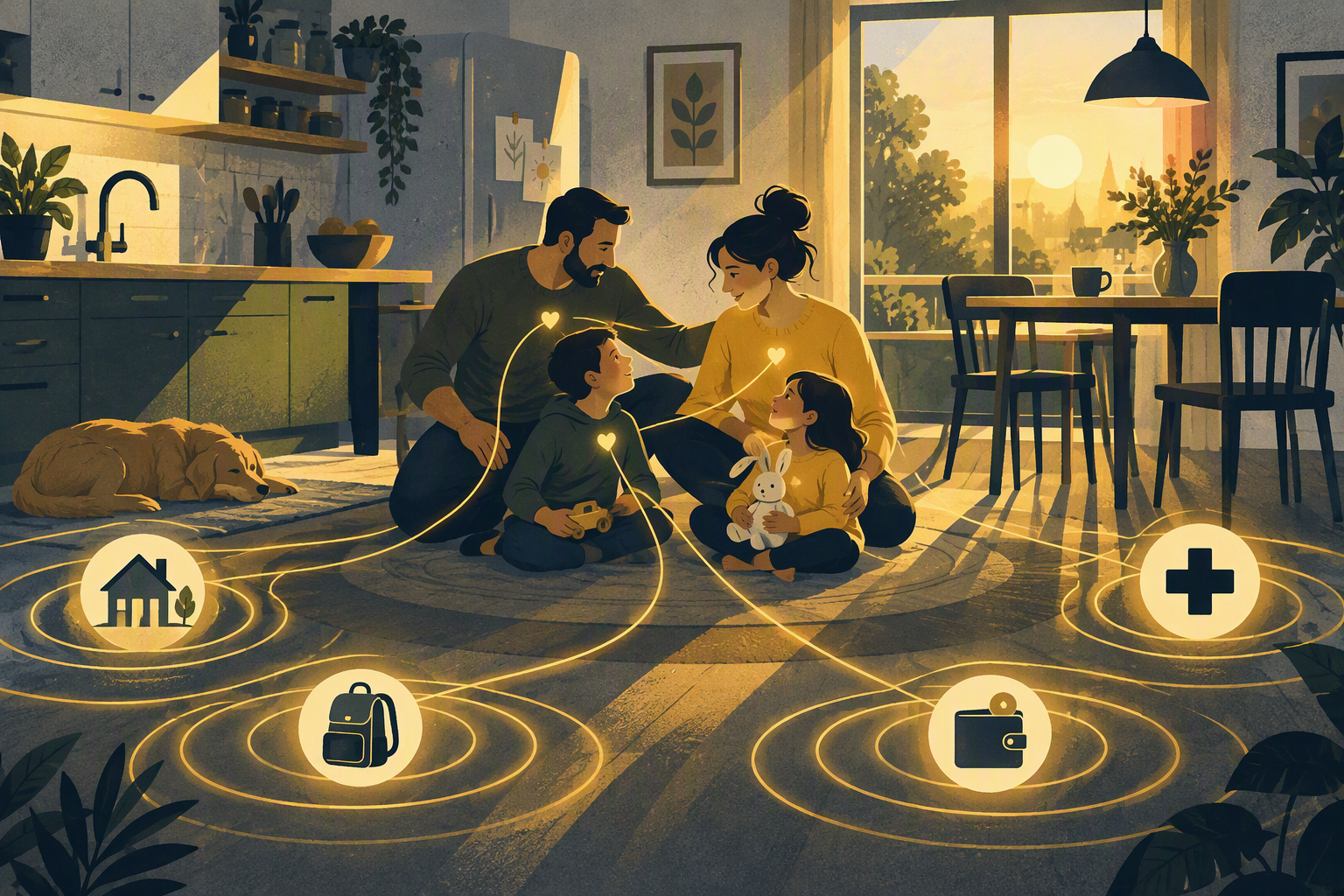
To this is added a wider circle of people affected by the war: civilians with injuries and disabilities, internally displaced persons, people returning from abroad, family members of the killed and missing, people released from captivity, caregivers. These categories partly overlap, so they cannot be mechanically added up into a single figure. This is an important statistical limitation of any forecast.
Scale is not only a question of numbers
As of 2025, more than 1.3 million people already had veteran status, and the government's future estimate of 5–6 million refers to veterans together with their family members. [2]
But the nature of the needs is even more important.
In February 2026 the WHO noted that the growing number of war-related injuries increases the need for rehabilitation; at the same time, only about 4% of hospitals provided inpatient rehabilitation, and assistive technologies such as prostheses and corrective devices were available in only about 3% of facilities. These figures are not a count of veterans with disabilities, but they show the limited infrastructure that people have to go through after severe injuries. [7]
A separate problem is administrative reintegration. A 2024 UNDP study among veterans and their families identified problems with discharge from service and with payments, obtaining status, social security and access to legal information. Among the veterans surveyed, 56% reported problems related to discharge or non-payment of wages, 49% to obtaining official status and 39% to social security. This is not a nationwide “prevalence” of each problem but the results of a specific study; nevertheless, they show well how many layers there are to the transition to civilian life. [8]
And finally, work.
In a survey by the Ukrainian Veterans Fund in January 2024, 30.95% of the veterans surveyed said they were unemployed. This figure cannot be extended to all veterans of Ukraine or, even less, multiplied by the future 5–6 million veterans and family members. It is a risk indicator, not a national forecast. [9]
At the same time, the Ukrainian economy needs people. The ILO records a labor shortage and skills mismatch, while in 2026 the State Employment Service simultaneously had tens of thousands of registered unemployed and considerable employer demand, with a very uneven ratio of vacancies to candidates depending on region and profession. In January–August 2026, the service was approached by, among others, about 13,000 participants in hostilities (UBD) and 29,000 people with disabilities. [4]
So the key problem is not necessarily a lack of vacancies. Often it is the distance between a specific person and a specific vacancy.
| Systemic risk | How it arises | What it threatens Ukraine with |
|---|---|---|
| Prolonged unemployment | Military experience has not been translated into the language of civilian professions; qualifications are outdated or the job is physically inaccessible | Loss of income, degradation of skills, reduced economic activity. |
| Economic inactivity after an injury | A person is assessed by diagnosis rather than by functional abilities; workplace adaptation is lacking | Ukraine loses workers precisely when the ILO records a labor shortage. [10] |
| “Running between systems” | Healthcare, social protection, education, employment, the community and the employer work in parallel | A person becomes the manager of their own reintegration. It is precisely the problem of fragmentation that the World Bank's new programs try to solve through integrated case management. [11] |
| Pressure on the family | Loss of income, care, relocation, the need for treatment or rehabilitation change the life of the whole household | A single unsuccessful professional transition can reduce the economic activity of several family members. Ukrainian policy already officially extends the approach to veterans' families. [12] |
| A shortfall in rehabilitation capacity | High demand after combat injuries against a limited network of services | Professional reintegration is postponed or takes place without sufficient recovery. [7] |
| Certificates without jobs | Education is funded as an end product rather than as a stage on the way to employment | The number of people “trained” grows, but the level of sustained employment may not change. International audits show why employment outcomes need to be measured separately. [13] |
| A fiscal trap | The system is better at assigning a status and a transfer than at returning to economic activity those who can and want to work | The state's long-term obligations grow, while the tax base and the supply of labor remain smaller. |

At the same time, an ethical line must be drawn clearly: employment cannot be a condition of dignity or a substitute for social protection.
A person with a severe injury should not have to prove their “usefulness” through work. For some the result will be a full-time job, for others remote or part-time employment, for others entrepreneurship or study, and for yet others long-term rehabilitation and the most independent life possible without any requirement to be employed. The American VR&E, for example, has, alongside its employment tracks, a separate Independent Living track for veterans who cannot return to work right away. [15]
So the goal of the system is not to force everyone to work, but not to lose those who can and want to return to economic life.
And there is one more fundamental reason to hurry. The Rapid Damage and Needs Assessment (RDNA5) puts Ukraine's recovery and reconstruction needs at almost $588 billion over the next decade. Infrastructure can be financed. Equipment can be bought. But human capital cannot be imported as quickly. [16]
International experience
No foreign model can simply be copied into Ukraine. The American labor market, the British professional army, the Israeli reserve system and Croatia's post-war experience are too different.
But almost everywhere that veteran reintegration works better, the same building blocks recur:
the transition begins before discharge; the person has a case manager or a personalized pathway; military competencies are translated into civilian language; the employer is part of the program; after employment the person is not left alone; and the result is measured not by the course but by life after the course.
| Country | What works | What exposed weaknesses | Lesson for Ukraine |
|---|---|---|---|
| United Kingdom | The Career Transition Partnership begins support for many service members as early as two years before discharge and continues it after service; for people with serious medical barriers there is CTP Assist. [17] | In 2024/25, among CTP users who reported their status after 6 months, 86% were employed, but among those discharged for medical reasons only 73%; 13% of the latter were unemployed and 16% economically inactive. This does not prove a causal effect of CTP, but it shows a much harder transition after injury. [18] | Start the civilian pathway before, not a year after demobilization; medical discharge requires a separate, more intensive pathway. |
| USA | VR&E offers different pathways: return to a previous employer, rapid job placement, retraining, entrepreneurship and independent living; the employer may be compensated for adaptation, equipment and part of the training or salary costs. [19] | The GAO found that almost a quarter of service members who needed maximum support during the transition had not completed the mandatory two-day module, and about 70% had not started TAP a year before discharge. Some technology and SkillBridge programs had gaps in collecting outcome data. [20] | Even a large system does not work automatically. What is needed is coverage, an early start and monitoring of results, not merely the existence of programs. |
| Canada | The National Veterans Employment Strategy works systematically on “translating” military skills, civilian accreditation, Veteran Ready employers and mentoring. In 2024/25, more than 2,100 veterans used Career Transition Services; almost 78% found work, about 18% returned to education, and 88% achieved at least one defined positive outcome. [21] | The Canadian strategy itself acknowledges the problem: employers often do not understand military occupations, and veterans do not know how to describe their experience in the language of the civilian market. [22] | Ukraine needs a national military-to-civilian skills translator and a mechanism for the official recognition of competencies. |
| Israel | The Rehabilitation Department works in a multidisciplinary way: medical, social, employment and welfare services are brought together around the person, and each veteran is assigned a portfolio manager. [23] | The sharp increase in the number of wounded after 2023 forced the government in 2025 to create a separate national commission to reduce bureaucracy, strengthen physical and psychological rehabilitation, support families and improve service delivery. [24] | Even a mature system can be overwhelmed by a mass influx. Capacity must be built before demand peaks. |
| Croatia | After the war, the state created rights to vocational rehabilitation, hiring incentives, self-employment, entrepreneurship and veteran cooperatives. [25] | In 2025 the OECD recorded one of the largest disability employment gaps in Europe. Spending on disability pensions amounted to about 1.4% of GDP; special conditions for veterans of the 1991–1995 war play a significant role in the system. This does not prove that veterans' benefits “caused” low employment, but it is a serious warning about a system in which the compensation component long outweighs activation and occupational rehabilitation. [26] | Income support is necessary, but it must not be made the state's only response for people who are able and willing to work. |

Another international tool that is especially useful for Ukraine is the Australian Recognition of Prior Learning. Australia funds universities so that they convert military experience into academic credits, direct-entry pathways and civilian qualifications. $1.65 million has been allocated to this program over three years. The idea is simple: a military logistician should not have to prove again after demobilization that he knows logistics; a commander, that he can lead people; a technical specialist, that he understands systems and equipment. [27]
This is especially important for Ukraine because retraining must not mean wiping out a person's biography.
A veteran should not “start life from scratch” but should receive help in translating accumulated experience into the new language of the economy.

Another international lesson is even more important: one cannot work only with the veteran and not work with the employer.
The American VR&E funds assistive technology and workplace modification, and for certain categories can subsidize on-the-job training and part of the salary. Canada teaches the market to be Veteran Ready. The British model connects the transition service directly to vacancies. [28]
That is why the formula “we gave the person a course, now let them look for a job” is fundamentally incomplete.
Scenarios for Ukraine
Any precise forecast of veteran unemployment after the end of the war would today be false precision.
We do not know the final number of demobilized personnel, their age and educational makeup, their health, the pace of demobilization, the geography of return, the state of the economy or the number of jobs at that time.
It is especially dangerous to make an arithmetic mistake: to take the 30.95% unemployment figure from the Ukrainian Veterans Fund (UVF) survey and multiply it by the government's 5–6 million. This is statistically incorrect, because the 5–6 million include family members, while 30.95% is the result of a specific survey of veterans who were no longer serving. [29]
Nevertheless, it is possible to build a scenario model that shows orders of magnitude.

Let us take a hypothetical cohort of 100,000 demobilized veterans.
As the starting point for the modeling — not as a forecast — we will use the 30.95% recorded by the Ukrainian Veterans Fund (UVF) survey in 2024. [9]
| Scenario | Hypothetical unemployment rate | Unemployed per 100,000 | Additionally employed compared with the inertial scenario | Additional gross payroll per year* | Approximate tax and contribution flow** |
|---|---|---|---|---|---|
| Inertial | 30,95% | 30 950 | — | — | — |
| Partial solutions | 25,95% | 25 950 | +5 000 | ≈ 1,2 UAH billion | ≈ 0,38–0,54 UAH billion |
| Systemic | 15,95% | 15 950 | +15 000 | ≈ 3,6 UAH billion | ≈ 1,13–1,62 UAH billion |
* For illustration, a gross salary of UAH 20,000 per month is assumed. This is a modeling assumption, not a forecast of veterans' average salary.
** The simplified calculation uses the personal income tax of 18%, the military levy of 5% and the unified social contribution (USC) in force in 2026: the general rate of 22% or the preferential 8.41% for employees with disabilities under the relevant conditions. This is not a “net budget effect”: the USC is an employer's contribution, some social benefits may continue regardless of employment, and the cost of the program itself is not taken into account here. [30]
The table does not predict the future. It shows the price of the difference between the scenarios.
A fifteen-percentage-point difference in employment is 15,000 people for every 100,000 in the relevant cohort.
That is 15,000 incomes.
15,000 professional roles.
15,000 people whose competencies work for the economy.
And — potentially — tens of thousands of family members, for whom the economic stability of the household increases.
For a cohort of one million, the arithmetic scale of the difference would already be 150,000 additionally employed, but this is merely a mechanical scaling of the model, not a forecast of the number of future unemployed veterans.
The inertial scenario
The state has dozens of separate instruments, but the connection between them is insufficient. A veteran receives rehabilitation in one place, information about education in another, a voucher in a third, vacancies in a fourth, and must settle the question of workplace adaptation with the employer himself.
In such a model, the most wounded or most exhausted person must have the greatest managerial competence, in order to assemble his or her own reintegration independently.
This is the logic that Ukraine is now trying to move away from through Veteran PRO, support specialists and the new integrated case management in social policy. But success will depend on whether these elements become a single process rather than merely a set of entry points. [31]
The partial-solutions scenario
The number of courses, grants, vouchers and programs grows, but the KPIs remain process-based:
“how many people were registered”;
“how many completed training”;
“how many received a certificate.”
This is better than inaction, but it does not guarantee a change in the economic trajectory.
The American experience with technology programs is a useful warning here: the GAO repeatedly criticized transition programs precisely because data on participation were collected better than data on actual employment and retention in the job. [32]
The systemic scenario
The state measures not the number of services but the person's transition.
A veteran or a person affected by the war receives a personal coordinator, a functional and professional assessment, recognition of prior experience, a specific pathway, short training tied to real demand, practice with an employer, workplace adaptation and support after hiring.
This direction is already visible in the World Bank's SPIRIT: the new system is meant to link social assistance, employment support, disability services and case management instead of separate institutional “corridors.” In May 2026 the World Bank approved a $880 million project for SPIRIT, intended to reach more than a million people; this is a broad social reform, not a purely veteran program. [33]
In this study the impact on GDP is deliberately not monetized. To obtain a correct figure, one needs data on the employment sector, productivity, hours worked, capital intensity, wages and value added of each group. To name a single percentage of GDP without such data would mean producing a neat but unreliable figure.
What is clear instead is the strategic direction: when recovery needs are estimated at almost $588 billion and the ILO at the same time speaks of a labor shortage, returning people to productive life has an economic effect far beyond the social protection system. [34]
The solution: retraining, new professions and AI
The most important principle of the future system can be put in a single sentence:
it is not the person who needs «to be fitted» to a profession — the professional pathway and the work environment must be adapted to the person's real capabilities.
This means abandoning the logic of “which professions are permitted to a person with this disability?”
Two people with the same formal disability status may have entirely different functional conditions, education, military experience, cognitive load, mobility, interests and required adaptations.
The right question is different:
what can and does the person want to do, under what conditions, with what technologies and what support?
Ukraine already has a mechanism for compensating employers for the costs of equipping workplaces for people with disabilities; its use grew in 2025–2026. This means the future system does not start from a blank sheet — the existing mechanism needs to be linked to the person's professional pathway. [35]
A single individual pathway
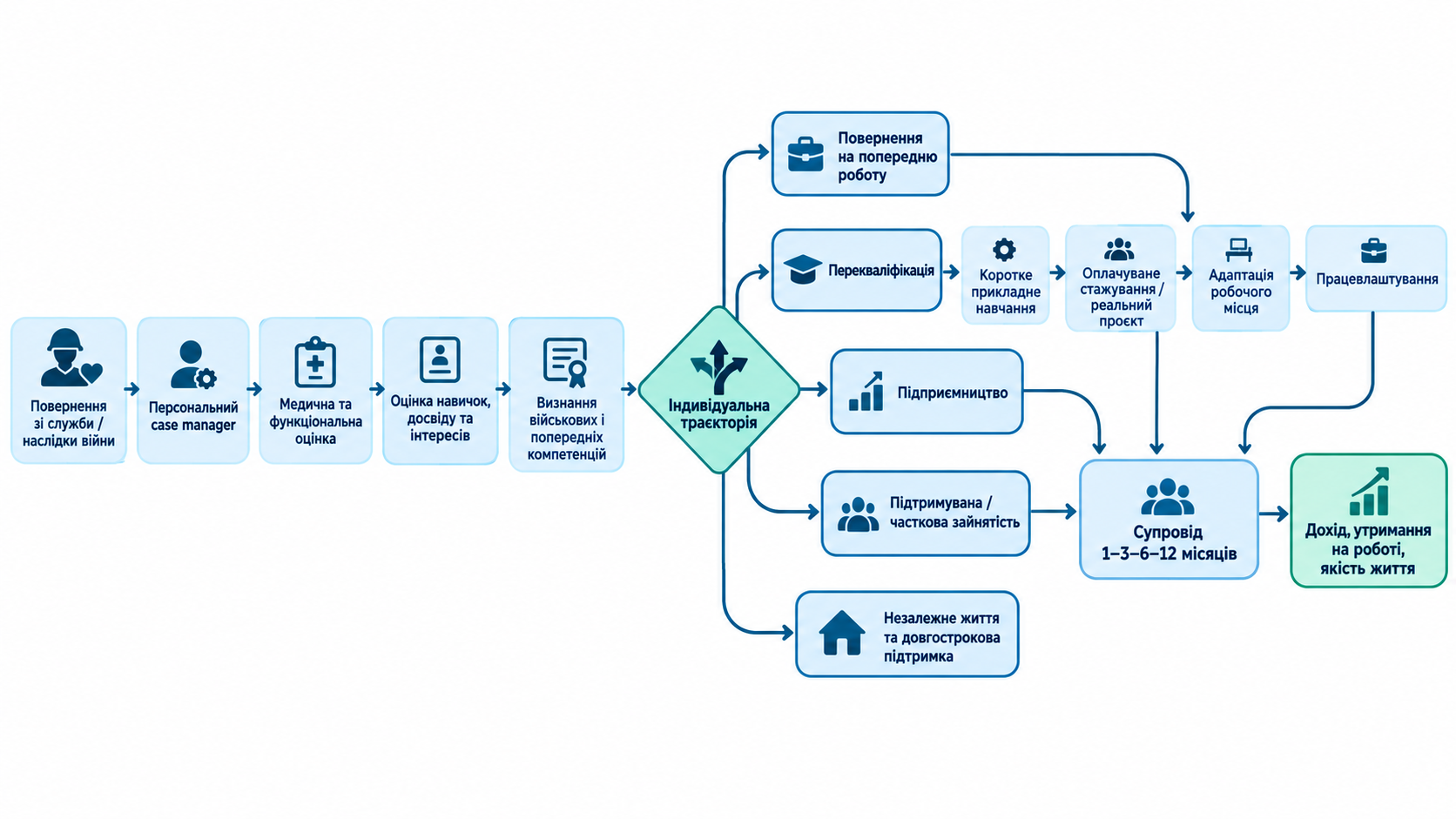
This architecture combines the logic of the British early transition, American individual vocational rehabilitation, Canadian skills translation and Australian recognition of prior learning. [36]

| Component of the Ukrainian program | What must happen | What outcome needs to be measured |
|---|---|---|
| A single point of entry | Veteran PRO / the community / a medical facility / a military unit hand the person over to a personal coordinator | Time from the request to the assignment of a case manager |
| Comprehensive assessment | Health, functional capabilities, prior education, military skills, digital skills, interests, family circumstances | Share of people with an individual plan |
| Recognition of Prior Learning | Military competencies are converted into understandable civilian skills, credits or qualifications | Share of competencies recognized without retraining |
| Career trajectory | Return to the previous job, a new profession, a business, partial/supported employment or an independent-living path | Share of people who have an agreed realistic goal |
| Learning | Microcredentials and short programs created together with the employer | Not the number of certificates, but employment conversion |
| Practice | Paid internship or a real project-based assignment | Share of participants who gained confirmed practical experience |
| Accessibility | Assistive technologies, software, transport, barrier-free access, a flexible/remote mode of work | Share of necessary adaptations actually implemented |
| Work or business | Job matching, employer partnership, grant, procurement opportunities | Income and employment |
| Post-employment support | Contact with the veteran and the employer after work begins | Retention at 6 and 12 months |
| Work with the family | If needed — career, psychological and social support for family members and caregivers | Household stability, not just the indicator of a single veteran |
«Education and the learning process itself — are not only about a diploma. They are an important element of the social adaptation and mental rehabilitation of veterans».
Artem Honcharenko, Head of the Veterans Institute “Architecture of Resilience” of KNUBA.
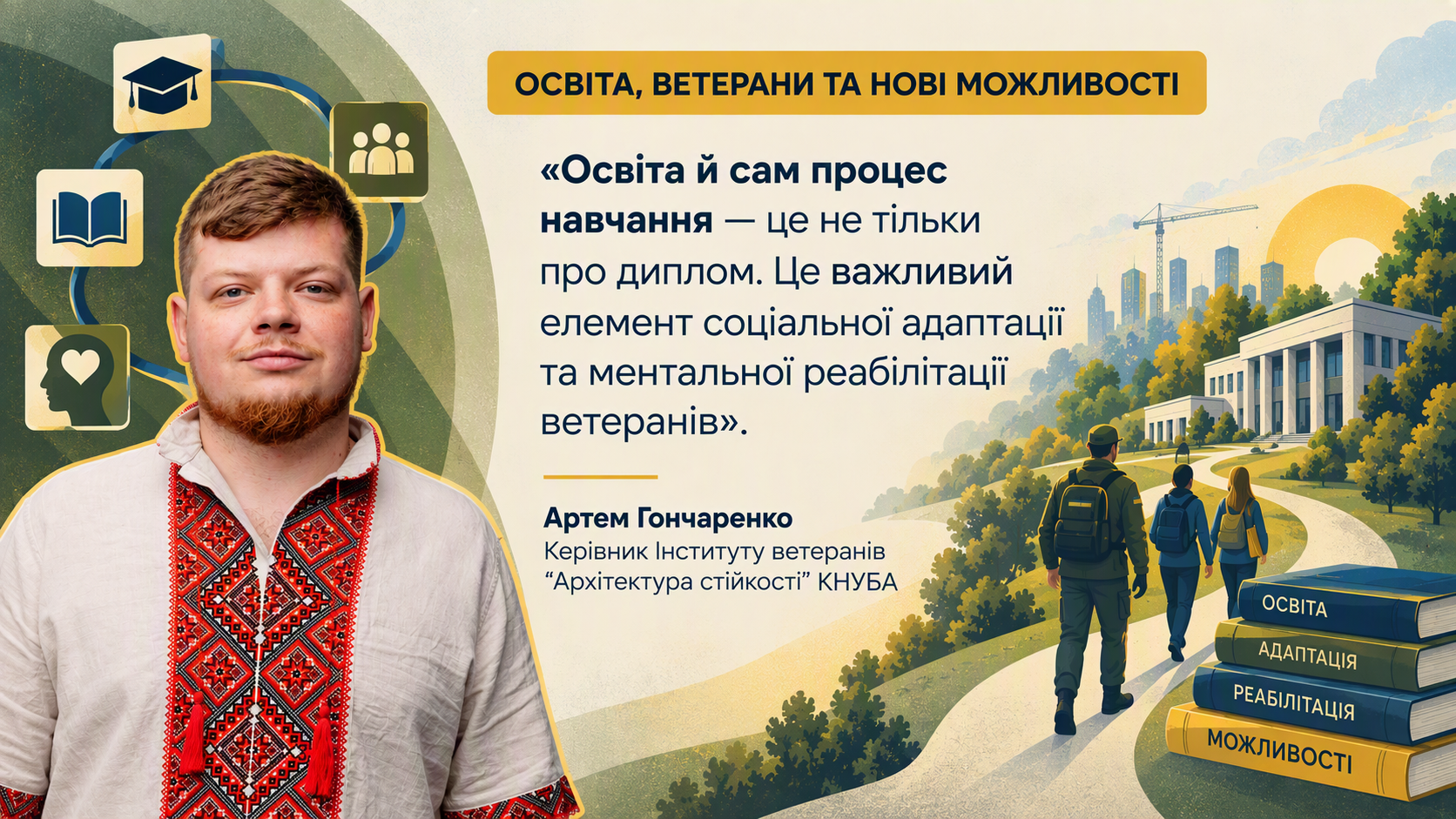
That is, education in veterans policy is not only the transfer of knowledge. It can become a space of transition between two identities: from a service member to a new professional and civic status.
But precisely for this reason, a course that ends with a certificate and has no employer at the other end is only half a bridge.
Professions must adapt to functional capabilities
For a person with limited mobility, remote or hybrid roles may be available in project management, data operations, GIS/BIM, digital administration, procurement, customer operations, analytics, cybersecurity or AI operations — if their education, abilities and condition match the tasks.
For a person who needs a flexible pace because of pain, fatigue or prolonged rehabilitation, the decisive factor may be not a “different profession” but a different design of working time.
For people with sensory impairments, screen readers, captions, voice interfaces, adapted software and information accessibility may be decisive.
Such solutions must be determined individually together with the person themselves, rehabilitation specialists and the employer. Disability is not a profession and must not turn into a list of pre-approved jobs.

AI creates a new class of opportunities
In the veterans context, artificial intelligence is interesting not because “AI is fashionable.”
It is interesting because the digital economy creates more and more work in which a person's main productive force is not physical effort but:
understanding of the process + work with information + discipline + responsibility + quality control + decision-making.
In September 2026 the National Agency of Ukraine on Civil Service (NAUCS) held for category “A” civil servants the program “Use of Artificial Intelligence Technologies in Managerial Activity.” The training was delivered by Mykhailo Vasianovych, CEO of SmartGT, coordinator of the School of Professional Development of KNUBA and of the AI Incubator of the Veterans Cluster of Ukraine. The program covered the integration of AI into work processes, prompt building and security issues. [38]
This is an important practical signal: part of the work around AI — is no longer about programming models but about managing digital processes.
The following professional profiles can be developed for this purpose:
| Working profile | Function |
|---|---|
| AI workflow operator | Runs standardized AI processes, monitors inputs and results, and hands complex cases over to a human expert |
| AI systems administrator / coordinator | Manages access, instructions, workflows, usage rules, documentation, and basic system monitoring |
| AI quality controller / reviewer | Checks the accuracy, compliance with requirements, sources, structure, and risks of AI responses |
| Knowledge-base curator | Keeps up to date the documents and corporate knowledge that AI systems use |
| AI-assisted analyst | Uses AI for the initial analysis of information, documents, and scenarios, and for preparing materials for a human's decision |
| AI project / service coordinator | Organizes the introduction of AI processes in a company, community, university, or government institution |
Their advantage for veterans' retraining is that for some of these roles there is no need to become a machine-learning engineer. What is needed is digital literacy, subject-matter knowledge, the ability to work by procedures, to monitor results, to work with data, and to follow security rules.
At the same time, this must not turn into a promise that “we will teach AI to all veterans.” AI is one track among several. Professional choice should be based on real economic demand and the person's abilities, and alongside it there must be pathways in construction and BIM, energy, GIS, logistics, cyber, project management, technical support, entrepreneurship, public and municipal administration, education, and other reconstruction sectors. This is exactly why the International Labour Organization stresses forecasting skills needs and linking vocational training to labor-market demand. [39]
«AI can already deliver practical results today — in working with documents, analytics, planning, and communications. Veterans can be not only users but also managers and administrators of AI systems: configuring processes and monitoring quality, data, and security».
Mykhailo Vasianovych, coordinator of the AI incubator of the Veterans Cluster of Ukraine.

Implementation roadmap
Ukraine does not need to create yet another parallel bureaucracy for veterans. Most of the necessary institutions already exist.
The Ministry of Veterans Affairs has Veteran PRO and a support network. The State Employment Service has vacancies, vouchers, and employer programs. The Ministry of Social Policy and the World Bank are building integrated case management. The health system has a rehabilitation track. Universities and vocational institutions have educational infrastructure. Communities know the local economy. Business has the jobs.
The task is not to build new vertical structures but to connect the existing ones horizontally — around the individual person. [31]
The best architecture could have three levels.
Universal level — an accessible labor market, rehabilitation, vocational education, disability inclusion, and social services for everyone affected by the war.
Veteran transition level — an early start even before demobilization, military skills mapping, a dedicated case manager, family support, legal issues, and veteran entrepreneurship.
Intensive level — for people with severe injuries and complex psychological or social needs: a lower caseload per case manager, longer support, and a supported employment or independent-living trajectory.

Who should be responsible for what
| Stakeholder | Key role | What the shared KPI should be |
|---|---|---|
| Cabinet of Ministers / Ministry of Veterans Affairs | Owner of the end-to-end pathway; case management standards; Veteran PRO; coordination | Share of people who received not a bundle of services but a completed transition pathway |
| Ministry of Economy / State Employment Service | Data on demand and vacancies, employer matching, vouchers, workplace adaptation | Employment and retention after 6/12 months |
| Ministry of Social Policy | Social services, family support, disability support, caregivers | Reduction in the time between a need arising and receiving comprehensive support |
| Ministry of Health / National Health Service of Ukraine / rehabilitation facilities | Medical and functional assessment, rehabilitation, assistive technology | Functional outcome and continuity of care |
| Ministry of Education and Science, universities, vocational education | RPL, microcredentials, retraining, career centers | Share of graduates working along the new trajectory |
| Communities | Local case management, transport, accessibility, social services, local employers | Results at the community level, not the number of events held |
| Employers | Shaping demand, internships, mentoring, workplace adaptation | Retention, salary, career progression |
| Veterans' organizations | Co-design, peer support, quality control, and feedback | Trust, satisfaction, grievance resolution |
| Institutes and university veteran centers | The “education → profession → employer” transition, piloting of new fields | Employment conversion after training |
| International partners | Technical assistance, data systems, pilots, impact evaluation | Scalability and evidence base of the solutions |
Nor does such a model need to be financed from a single source.
In 2026 the state has already earmarked UAH 18.9 billion for veterans policy, although these funds cover many areas and are not a budget solely for employment. [43]
The World Bank's SPIRIT has a volume of $880 million and supports a broad reform of social protection, disability support, employment links, and case management; it likewise cannot be presented as “$880 million for veterans,” but it creates infrastructure on which veteran reintegration can rely. [33]
The EU and the ILO separately launched a three-year program worth €3.8 million to modernize labor governance and to include veterans, internally displaced persons, women, young people, and people with disabilities. [44]
The financial architecture can therefore combine government programs, community budgets, compensation for employers, vocational-education funds, international technical assistance, and private co-financing — but only after it is clearly defined who pays for which result.
KPIs must change the behavior of the system
If a university is paid for the number of people trained, it optimizes the number of people trained.
If the employment service cares about the number of people registered, it optimizes registration.
If the grantmaker counts the grants it has issued, the system optimizes grants.
Therefore the main KPI must shift from output to outcome.
It makes sense to include the following in the national dashboard:
| Level | KPI |
|---|---|
| Entry into the system | Average time from application/demobilization to a comprehensive assessment |
| Competencies | Share of people whose prior learning is recognized instead of full retraining |
| Education | Share of participants who completed training and moved on to practice |
| Practice | Share of participants with a paid internship / real project |
| Employment | Employment rate 3/6 months after the program |
| Quality of employment | Retention at 6 and 12 months |
| Economic outcome | Median change in labor income from the baseline |
| Disability and accessibility | Share of the necessary accommodations that are actually implemented and in use |
| Entrepreneurship | Business survival after 12/24 months, not just the number of grants |
| Family | Change in the household's economic and social stability |
| People for whom work is not a goal | Functional independence, access to rehabilitation, and quality of life |
| Fairness | Results broken down by sex, region, type of barrier, and disability |
This means a fundamental change in the logic of the state:
not «we provided a person with 11 services», but «after 12 months we know what has happened to them».
This is precisely what even wealthy and long-established veterans' systems often lack. The American GAO has repeatedly found programs in which there was more data on completing the procedure than data on the long-term result. [45]
And it is precisely here that Ukraine has a chance not to repeat others' mistakes but to build a next-generation system right away.
Not a system of a lifelong “support status.”
But a system of transition.
Not a system in which a veteran has to prove what they can no longer do.
But a system that determines what they can do next.
Not a system that sees a disability in a person.
But a system that sees functional capabilities, competencies, experience, and the necessary accommodations.
Not a system that counts the certificates issued.
But a system that counts sustainable professional trajectories.
And not a system that places the veteran in a separate economy of “veteran professions.”
But a system that makes the ordinary Ukrainian labor market accessible to people who have been through war.
This is the main conclusion of the study.
The problem for Ukraine is not that there will be many veterans and people with disabilities after the war. The problem may be the inability of the state, the economy, and society to return their potential to active life.
The government estimate of 5–6 million veterans and their family members conceals not only the scale of future obligations. It also conceals the scale of opportunity. [46]
With the right policy, this is not about millions of people whom Ukraine will have to “support.”
It is about people who can become entrepreneurs, engineers, managers, teachers, reconstruction specialists, project managers, BIM and GIS specialists, administrators of digital systems, AI coordinators, community specialists, mentors, and employers.
Some of them have already learned during the war to manage teams, complex systems, resources, risks, and uncertainty.
The task after the war is not to lose this experience on crossing the threshold into civilian life.
Then veterans policy ceases to be merely a response to the consequences of war.
It becomes one of the mechanisms for rebuilding the country.

Our contacts:
Instagram: @uaveteranscluster, @ veteranoknuca, @ future_ukr, @ namir.fund
Facebook: https://www.facebook.com/veteranoknuca/, https://www.facebook.com/uaveterancluster/
Linkedin: https://www.linkedin.com/company/veterano-ukraine/ https://www.linkedin.com/company/uaveterancluster/
Website: veterano.info
Sources and notes
| Source | Use in the study |
|---|---|
| Cabinet of Ministers of Ukraine, estimate of the future number of veterans and family members — about 5–6 million | Scale of the potential veterans-policy ecosystem. [46] |
| Ministry of Veterans Affairs, Veterans Policy Strategy through 2030 | The existing state strategic framework. [42] |
| Cabinet of Ministers / Ministry of Defense, over 1.3 million people with the status of war veteran | Current size of the veterans' community. [47] |
| Ministry of Veterans Affairs, Veteran PRO, and the network of support specialists | Existing elements of the “single window” model and case support. [48] |
| Ministry of Veterans Affairs, State Budget 2026 | UAH 18.9 billion for veterans policy in 2026. [43] |
| Ukrainian Veterans Fund | Survey on veterans' employment; 30.95% unemployed within a specific surveyed group of veterans who were no longer serving. [9] |
| ILO, Decent Work Country Programme Ukraine 2026–2029 | Labor shortage, skills mismatch, barriers for veterans, internally displaced persons, and people with disabilities. [10] |
| WHO Europe, 2026 | Limited access to inpatient rehabilitation and assistive technologies amid rising needs caused by war injuries. [7] |
| UNDP, Survey on the Legal Needs of Veterans and Their Family Members | Legal and administrative barriers faced by veterans and families. [8] |
| World Bank, SPIRIT | Transition to integrated case management, employment-linked support, and a new disability architecture. [11] |
| World Bank / Government of Ukraine / EU / UN, RDNA5 | Nearly $588 billion in recovery and reconstruction needs over the course of a decade. [16] |
| UK Ministry of Defence, Career Transition Partnership Statistics 2024/25 | Employment outcomes after six months, including separately for medical discharge. [18] |
| GOV.UK, Career Transition Partnership guidance | Early start of transition support and special support for people with medical barriers. [17] |
| U.S. Department of Veterans Affairs, VR&E | Individual pathways for employment, retraining, self-employment, and independent living. [19] |
| U.S. Government Accountability Office | Independent assessment of weaknesses in TAP, SkillBridge, warm handovers, and outcome measurement. [49] |
| Veterans Affairs Canada | National Veterans Employment Strategy, skills translation, employer readiness, and the results of Career Transition Services. [50] |
| Israel Ministry of Defense | A multidisciplinary rehabilitation model and scaling problems during a sharp rise in the number of wounded. [51] |
| Government of Croatia and the OECD | Employment/self-employment/vocational rehabilitation instruments and the long-term risks of a large disability employment gap and substantial disability-pension expenditures. [52] |
| Australian Department of Veterans' Affairs | Recognition of Prior Learning and the conversion of military experience into academic credits and civilian qualifications. [27] |
| Working document provided by the user | Initial theses and structure, additionally verified against primary and official sources. fileciteturn0file0 |
[5] [42] Ministry of Veterans Affairs
[2] https://www.facebook.com/reel/920972490557834
[3] [10] [39] Decent Work Country Programme Ukraine 2026-2029 | International Labour Organization
https://www.ilo.org/resource/report/decent-work-country-programme-ukraine-2026-2029
[4] State Employment Service
https://dcz.gov.ua/stat/stattrend
[6] [12] Yulia Svyrydenko: Veterans policy should cover not only veterans but also their families | Cabinet of Ministers of Ukraine
[7] Attacks on Ukraine’s health care increased by 20% in 2025
[8] Survey on the Legal Needs of Veterans and Their Family Members | United Nations Development Programme
https://www.undp.org/ukraine/publications/survey-legal-needs-veterans-and-their-family-members
[9] [29] Unemployment rate among veterans is growing: research shows
https://veteranfund.com.ua/en/2024/02/13/unemployment-rate-among-veterans-is-growing-research-shows/
[11] Social Protection for Inclusion, Resilience, Innovation and Transformation (SPIRIT) Program for Ukraine
https://www.worldbank.org/en/brief/2025/12/16/spirit
[13] Helping Service Members Transition Back to Civilian Life | U.S. GAO
https://www.gao.gov/helping-servicemembers-transition-back-to-civilian-life
[14] Adequate and accessible social support for vulnerable groups in Croatia: OECD Reviews of Labour Market and Social Policies: Croatia 2025 | OECD
[15] [19] VR&E Support-And-Services Tracks | Veterans Affairs
https://www.benefits.va.gov/vocrehab/employment_tracks.asp
[16] [34] Updated assessment of Ukraine's recovery and reconstruction needs published
[17] [36] Career Transition Partnership - GOV.UK
https://www.gov.uk/guidance/career-transition-partnership
[18] Career Transition Partnership Statistic: 1 April 2024 to 31 March 2025
[20] [49] Servicemembers Transitioning to Civilian Life: DOD Could Enhance the Transition Assistance Program by Better Leveraging Performance Information | U.S. GAO
https://www.gao.gov/products/gao-23-106793
[21] [50] National Veterans Employment Strategy | Veterans Affairs Canada
[22] National Veterans Employment Strategy | Veterans Affairs Canada
[23] [51] Rehabilitation Department | Homepage
https://www.mod.gov.il/en/departments/rehabilitation-department
[24] Israel Launches National Committee to Address Crisis in Care for Wounded Security Personnel | Homepage
[25] Self-employment aid - gov.hr
https://www.gov.hr/en/self-employment-aid/918
[26] The labour market and social situation in Croatia: OECD Reviews of Labour Market and Social Policies: Croatia 2025 | OECD
[27] Third round of grants to support veterans into tertiary study | Department of Veterans' Affairs
[28] For Employers - Veteran Readiness and Employment - Veteran Readiness and Employment (VR&E)
https://www.benefits.va.gov/vocrehab/employers.asp
[30] Berdychiv State Tax Inspectorate: On the need to pay wages no lower than the minimum wage and the electronic services of the State Tax Service
https://zt.tax.gov.ua/media-ark/local-news/987337.html
[31] [48] Veteran PRO: all government services for war veterans and their families on one portal | Cabinet of Ministers of Ukraine
[32] [45] Transition to Civilian Life: Better Collection and Analysis of Military Service Data Needed to Improve Oversight of the SkillBridge Program | U.S. GAO
https://www.gao.gov/products/gao-24-107352
[33] New World Bank Project will Help Transform Ukraine's Social Protection System
[35] In 2025, the number of people with disabilities who used the services of the Employment Service increased | Donetsk Regional Employment Center
[37] Education and retraining are the path of return for veterans – Veterans Institute
https://veterano.knuba.edu.ua/osvita-ta-perekvalifikatsiia-tse-shliakh-povernennia-dlia-veteraniv/
[38] [40] [41] AI in management work: training held for civil servants of category “A” | National Agency of Ukraine on Civil Service Issues
[43] Ministry of Veterans Affairs
[44] ILO and EU launch a project to strengthen Ukraine’s labour market governance | International Labour Organization
[46] Yuliia Svyrydenko: Ukraine is the first state to build a comprehensive veterans policy during wartime | Cabinet of Ministers of Ukraine
[52] Finding employment - gov.hr